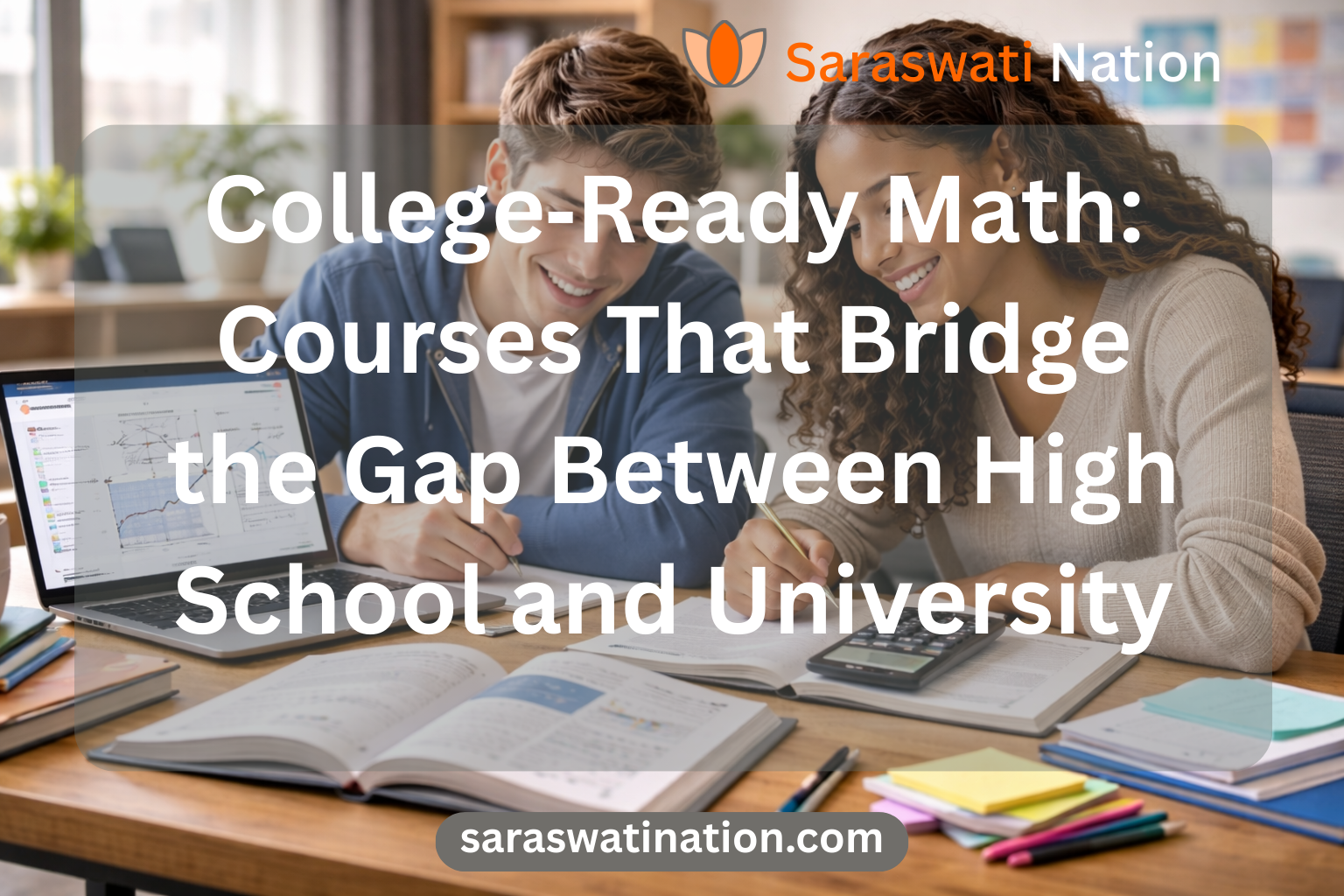
University‑Ready Math: Courses That Bridge the Gap Between High School and Higher Education
Transitioning from high‑school mathematics to university‑level coursework is one of the biggest academic hurdles for students and a source of anxiety for parents. While most secondary‑school curricula cover fundamental topics—linear equations, basic geometry and introductory statistics—universities expect a deeper conceptual understanding, stronger proof‑writing skills, and fluency with more abstract subjects such as calculus, discrete mathematics and advanced statistics.
The good news is that university‑ready math courses designed specifically to bridge this gap already exist, and they can be delivered entirely online. In this article we’ll explore the key content areas that separate high‑school from university math, highlight the most effective course structures, and show how Saraswatination’s online programmes can give your teen the confidence and competence needed for a smooth STEM transition.
Why the Gap Exists
| High‑School Focus | University Expectation |
|---|---|
| Procedural calculations (plug‑and‑play) | Conceptual reasoning and proof techniques |
| Limited exposure to mathematical rigor | Emphasis on abstraction, notation, and logical argument |
| Isolated topics (e.g., “solve quadratic equations”) | Integrated problem solving across multiple domains |
| Minimal use of technology for modelling | Requirement to use software (MATLAB, Python, R) for data analysis and simulation |
Research from the National Center for Education Statistics shows that students who enter college without a solid foundation in university‑ready math preparation are twice as likely to withdraw from STEM majors. Closing the gap early reduces remediation costs for universities and improves graduation rates.
Core Topics Covered in University‑Ready Math Courses
- Advanced Algebra & Functions
- Polynomial division, rational functions, and complex numbers
- Transformations, inverses, and composition of functions
- Real‑world modelling using systems of linear and nonlinear equations
- Geometry & Trigonometry at Depth
- Proof‑based Euclidean geometry (congruence, similarity, circle theorems)
- Analytic geometry in three dimensions
- Trigonometric identities, polar coordinates, and applications to wave phenomena
- Introductory Calculus
- Limits, continuity, and the formal definition of a derivative
- Integration techniques, the Fundamental Theorem of Calculus, and area problems
- Simple differential equations and modelling population growth or decay
- Statistics & Probability
- Descriptive statistics, distributions, and hypothesis testing
- Binomial, normal, and Poisson models with real data sets
- Introduction to statistical software (Excel, Google Sheets, or free R scripts)
- Discrete Mathematics & Logic
- Set theory, combinatorics, and basic graph theory
- Logical statements, proofs by induction, and algorithmic thinking
- Foundations for computer science and engineering courses
- Problem‑Solving Strategies
- Heuristics such as “draw a diagram,” “work backwards,” and “consider extreme cases”
- Structured practice with past university entrance exams (SAT Math, ACT Math, UK A‑Levels)
Each module is built around interactive video lessons, guided practice problems, and instant feedback—the three pillars of effective online learning for math.
What Makes an Effective University‑Ready Math Course?
| Feature | Why It Matters for the Student | SEO Phrase |
|---|---|---|
| Modular design | Allows learners to focus on weak areas without re‑learning material they already master. | “modular university math courses” |
| Live tutoring sessions | Provides real‑time clarification, mimicking the support of a classroom teacher. | “online math tutoring for high school” |
| Adaptive quizzes | Uses algorithms to adjust difficulty, keeping the student in the optimal zone of proximal development. | “adaptive math quizzes” |
| Proof‑writing workshops | Trains students to articulate logical arguments—a skill heavily weighted in university assessments. | “proof writing for university math” |
| Technology integration | Early exposure to tools like Desmos, GeoGebra, and Python prepares students for university labs. | “technology‑enhanced math learning” |
| Progress dashboards | Gives parents and students transparent metrics on mastery, helping to set realistic goals. | “math progress tracking online” |
When these components are combined, the result is a high‑impact learning experience that not only raises test scores but also builds the analytical mindset required for STEM degrees.
How Saraswatination’s Courses Fit the Bill
Saraswatination offers a curated suite of University‑Ready Math programmes that align perfectly with the topics listed above. Here’s what you can expect from each course package:
- Complete Curriculum Bundle – 12‑week intensive covering all six core topics, with weekly live Q&A sessions hosted by experienced university tutors.
- Focused Skill Tracks – Choose a single module (e.g., “Introductory Calculus”) for a 4‑week deep dive, ideal for students who need targeted reinforcement.
- Self‑Paced Learning Lab – Unlimited access to recorded lessons, interactive worksheets, and a community forum where peers solve problems together.
All courses are hosted on a secure LMS, compatible with desktop, tablet and mobile devices, and include downloadable PDFs for offline practice.
Success Stories
| Student (Age) | Course Taken | Measured Outcome |
|---|---|---|
| Maya, 17 (high‑school senior) | Full Curriculum Bundle | Raised SAT Math score from 680 to 750; earned a scholarship for engineering. |
| Luis, 16 (grade 11) | Calculus Skill Track | Completed first‑year university calculus with a B+ after only 8 weeks of prep. |
| Priya, 15 (grade 10) | Self‑Paced Lab | Improved problem‑solving speed by 35 % on mock A‑Level exams. |
These results illustrate how a well‑structured university‑ready math course can translate directly into higher admission test scores, smoother first‑year university performance, and increased confidence in STEM subjects.
The Value Argument – Education Is Free in Denmark
In Denmark, higher education is tuition‑free, which means the primary investment is your child’s time and preparedness. By enrolling in a university‑ready math course you:
- Save future tutoring costs – A solid foundation reduces the need for expensive private remediation later.
- Increase scholarship eligibility – Higher test scores open doors to merit‑based awards that can cover living expenses.
- Accelerate degree completion – Better preparation often translates into fewer failed courses, allowing students to graduate on schedule.
- Reduce stress for the whole family – Knowing the math basics are mastered frees up mental bandwidth for other academic pursuits and extracurricular activities.
Thus, the course pays for itself through time saved, reduced ancillary expenses, and enhanced academic outcomes—all while aligning with Denmark’s commitment to free higher education.
Choosing the Right Course for Your Child
- Assess the current level – Use a diagnostic quiz (available free on our shop page) to pinpoint gaps.
- Match the need – If the student struggles across the board, opt for the Complete Curriculum Bundle. If the weakness is isolated (e.g., calculus), select a Focused Skill Track.
- Consider scheduling – Live tutoring sessions are held twice weekly; ensure they fit the student’s existing commitments.
- Set measurable goals – Define target scores (SAT, ACT, A‑Levels) and track progress via the LMS dashboard.
Take the Next Step
Preparing your teen for university‑level mathematics doesn’t have to be a gamble. With the right university‑ready math courses, you can close the high‑school‑to‑higher‑education gap, boost confidence, and lay the groundwork for long‑term STEM success.
Buy a course today and give your child the tools they need to thrive:
- Visit our shop here: https://saraswatination.com/shop/
If you have questions, need a personalised learning plan, or want to discuss which programme best fits your student’s goals, contact us now:
- Contact us here: https://saraswatination.com/contact/
Empower your teenager with the math foundation that universities expect—and watch their academic future take off.

You may also like
The Parent’s Guide to Monitoring Online Learning Progress Safely