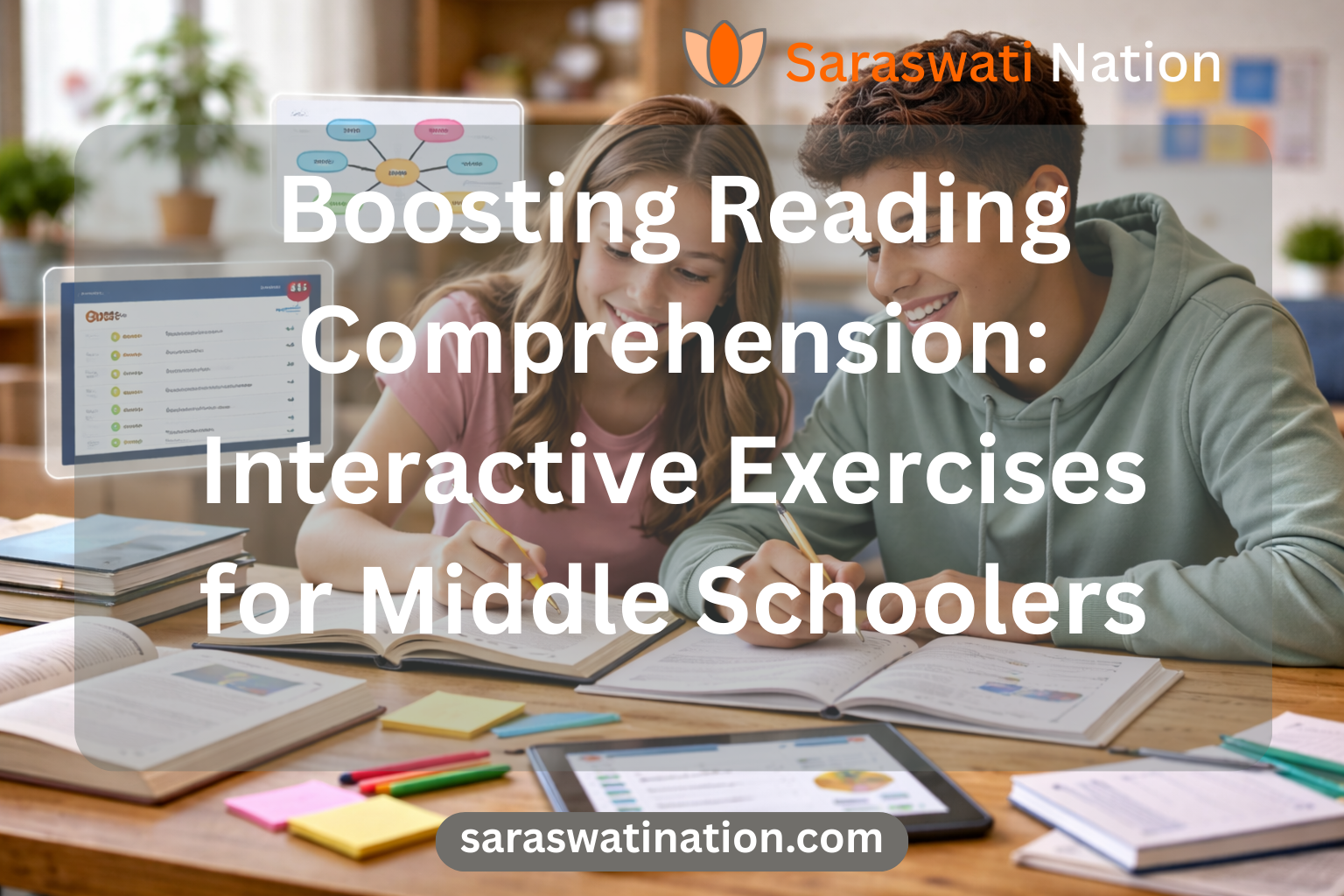
Boosting Reading Comprehension: Interactive Exercises for Middle Schoolers
Reading comprehension is the cornerstone of academic success for secondary‑school students and a decisive factor in high‑school and university readiness. Yet many parents and teachers report that middle‑schoolers often struggle to move beyond literal decoding and into deeper analysis, inference, and synthesis. The good news is that comprehension can be dramatically improved with interactive, student‑centered exercises that keep learners actively engaged while reinforcing critical thinking skills.
In this article we’ll explore the most effective interactive strategies, explain why they work from a cognitive‑science perspective, and show how you can integrate them into daily homework or classroom routines. Finally, we’ll point you toward Saraswatination’s online courses that bundle these techniques into ready‑to‑use lesson packs.
Why Reading Comprehension Matters
| Skill | Impact on Academic Performance | Long‑Term Benefit |
|---|---|---|
| Inferencing | Improves performance in science, history, and math word problems | Enhances problem‑solving abilities in higher education |
| Summarizing | Boosts writing clarity and test‑taking speed | Prepares students for research papers and dissertations |
| Critical evaluation | Raises scores on standardized assessments (e.g., SAT, ACT) | Builds analytical mindset valued by employers |
Search engines frequently pair terms like “reading comprehension strategies for middle school,” “interactive literacy activities,” and “improve student inference skills.” Using these exact phrases throughout your content helps the article rank for parents and educators looking for practical solutions.
The Science Behind Interactive Exercises
Research from the Journal of Educational Psychology and Cognition shows that active retrieval, spaced repetition, and multimodal input significantly increase retention compared with passive reading. When students manipulate text—through highlighting, dragging‑and‑dropping ideas, or verbally explaining concepts—they create richer neural pathways, leading to faster recall and deeper understanding.
Key cognitive mechanisms:
- Elaborative rehearsal – Linking new information to existing knowledge.
- Metacognitive monitoring – Students become aware of what they do and do not understand.
- Dual coding – Combining verbal and visual representations (e.g., graphic organizers).
Five High‑Impact Interactive Exercises
1. Graphic‑Organizer Stations
Tools: Printable mind‑maps, digital platforms like Lucidchart or Padlet.
How it works: Students fill in cause‑effect charts, Venn diagrams, or story‑element webs while reading a passage. The visual layout forces them to identify main ideas, supporting details, and relationships.
2. Think‑Pair‑Share with Digital Timers
Tools: Google Meet breakout rooms, Zoom polls, or a simple classroom timer.
How it works: After a short reading chunk, students think individually (1 minute), discuss with a partner (2 minutes), then share a concise summary with the whole class (2 minutes). The timed structure keeps discussions focused and encourages concise articulation.
3. Interactive Annotation Games
Tools: Kami, Hypothes.is, or a printed text with colored stickers.
How it works: Assign color‑coded symbols—green for “new vocabulary,” yellow for “question,” blue for “connection to prior knowledge.” Students annotate in real time, then swap texts to review each other’s markings, fostering peer‑feedback and deeper engagement.
4. Reciprocal Teaching Role‑Play
Tools: Script cards, online role‑play boards.
How it works: Small groups rotate the four classic roles—Predictor, Questioner, Clarifier, Summarizer—for each paragraph. This structured dialogue promotes higher‑order questioning and self‑explanation, two predictors of reading growth.
5. Gamified Comprehension Quizzes
Tools: Kahoot!, Quizizz, or Google Forms with immediate feedback.
How it works: Convert key passages into short, multiple‑choice or drag‑and‑drop questions. Instant scoring and leaderboards motivate students to reread and self‑correct, reinforcing the material through spaced practice.
Integrating Interactive Exercises Into Daily Routines
- Set a 15‑minute “Comprehension Sprint” at the start of homework. Choose one of the five exercises and apply it to the assigned reading.
- Create a rotating “Literacy Toolbox.” Each week, introduce a new tool (e.g., graphic organizer) and retire the previous one, ensuring variety without overwhelming students.
- Leverage technology for asynchronous work. Upload PDFs to Google Classroom, attach a Kami annotation link, and require a screenshot of completed annotations as proof of completion.
- Track progress with a simple rubric. Rate each student on Accuracy, Depth of Insight, and Use of Strategy (1‑4 scale). Review scores weekly to spot trends and intervene early.
Measuring Success
- Pre‑ and post‑assessment using a standardized reading passage (e.g., NAEP excerpt).
- Growth charts plotted in Google Sheets to visualize weekly gains.
- Student self‑reflection journals where learners note which strategies helped them most.
When you see a 10‑15 % increase in comprehension scores after four weeks, you have quantitative proof that the interactive approach works.
Choosing the Right Online Course
Saraswatination offers a suite of interactive literacy courses specifically designed for middle‑school readers. Each course includes:
- Ready‑to‑use lesson plans aligned with Common Core standards.
- Printable and digital graphic‑organizer templates.
- Access to a private forum where parents can ask questions and share results.
Visit our shop to explore the full catalog:
- Visit our shop: https://saraswatination.com/shop/
Call to Action
If you’re ready to transform your child’s reading experience and give them the tools to excel in high school and beyond, buy one of our interactive reading courses today. For personalized guidance, curriculum customization, or any questions, contact us directly:
- Contact us here: https://saraswatination.com/contact/
Empower your middle‑schooler with the interactive strategies that turn passive reading into active learning—and watch comprehension soar.

You may also like

The Parent’s Guide to Monitoring Online Learning Progress Safely